
Black Polyamide Hot Melt Adhesive UA-G185C
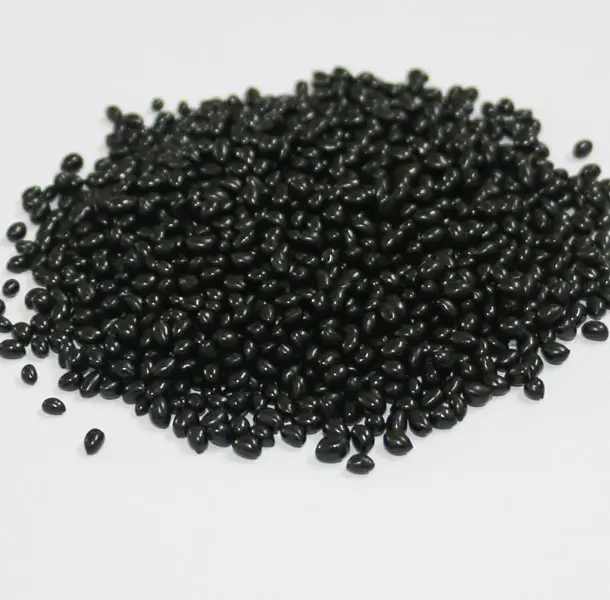
UA-G185C is a black polyamide hot melt adhesive in granule form. It serves low pressure molding (LPM) encapsulation and sealing in automotive, electrical and electronic assemblies. Its melting range is 165-182 °C and its melt viscosity is 5,000-7,000 mPa·s at 210 °C. That melt is deliberately heavier than a general-purpose LPM polyamide, because the parts it seals are larger and thicker. Many of them are also moulded against a vertical wall. The black colour is a functional specification, not a cosmetic one.
Why the grade is black
Sensor housings, connector bodies and ECU covers in automotive electronics are almost always black. A translucent amber encapsulant therefore shows through thin walls, flashes at the parting line and discolours at the gate. An opaque black grade gives a visually consistent part that passes customer appearance inspection. It also blocks light where an optical or infrared sensor sits behind the wall. Finally, it stops dust and flux residue from being visible through the seal.
Low pressure molding is what the grade is designed around. Conventional injection moulding overmoulds a sensor or a PCB area at high pressure. LPM, by contrast, injects molten adhesive into a closed mould at a fraction of that pressure. As a result, solder joints, wire insulation, bond wires and MEMS elements survive. No chemical reaction takes place during solidification, so no curing oven is needed.
Polyamide is the chemistry of choice. It combines a high melting range with toughness and strong adhesion to the polar surfaces inside electronic assemblies. Those surfaces include polyamide, PBT, FR-4, copper, brass and pretinned wire. The higher melt viscosity is also a process advantage on real production lines.
A heavier melt stays where it is placed. It resists wicking into wire strands and capillary gaps, and it holds its shape on vertical walls before crystallisation. Because it flows less, it also produces less flash at the parting line. That means less deflashing and fewer contaminated contacts.
The trade-off is honest. A low-viscosity grade fills extremely fine clearances more readily. UA-G185C is therefore the right choice for cavities of normal to large section, and the wrong choice only for hair-thin gaps.
Key Features
- Opaque black — matches black housings, blocks light for optical and IR sensors, and hides seams, flash and contamination that show through translucent grades
- High melt viscosity, 5,000-7,000 mPa·s at 210 °C — stays where it is placed, resists wicking into wire strands, holds shape on vertical walls
- Low pressure molding — a fraction of conventional injection pressure, so solder joints, wire insulation and MEMS survive encapsulation
- No chemical reaction, no curing oven — the part is solid on cooling and can be demoulded within the cycle, not after hours of cure
- Strong adhesion to engineering plastics and metals — bonds to PA, PBT, FR-4, copper and pretinned surfaces without a primer
- Reworkable — reheat the part and the encapsulant softens, so a failed component is repaired instead of scrapped
- Field-proven applications — TPMS, seat occupant detection boards, belt buckle sensors, motorcycle ECUs, air quality sensors and RF antennas
- Granule form — dust-free, easy to meter into a hot melt tank, melts to a homogeneous low-foam melt
Technical Specifications
| Property | Value |
|---|---|
| Main component | Polyamide (PA) hot melt adhesive |
| Model | UA-G185C |
| Appearance | Black granules |
| Melting range | 165-182 °C |
| Melt viscosity | 5,000-7,000 mPa·s (210 °C) |
| Recommended process | Low pressure molding (LPM) |
| Substrates | PA, PBT, FR-4, copper, brass, pretinned wire |
| Packaging | Sealed moisture-barrier bags, pack size confirmed per order |
| Storage | Cool, dry and sealed; dry before use if moisture has been absorbed |
Values are typical laboratory figures. Final acceptance criteria are confirmed against the batch certificate of analysis.
Processing Guide
| Step | What to do | Why it matters |
|---|---|---|
| Pre-dry | If the granules have been exposed to humid air, dry them before charging the tank | Polyamide is hygroscopic; moisture turns to steam in the melt and shows up as bubbles, voids and weak bonds |
| Melt | Heat above the top of the melting range until the melt is fully clear and homogeneous; avoid long residence at high temperature | Unmelted crystals act as weak points, while extended heating degrades the polymer and darkens the colour |
| Mould | Inject at low pressure into a closed mould; the heavier melt tolerates simple gates and larger sections | Low pressure is what protects the assembly; the higher viscosity keeps the melt from flashing past seals |
| Demould | Open the mould once the part has crystallised and is dimensionally stable | Cycle time is seconds, not hours, so no curing oven or buffer stock is needed |
| Rework | Reheat the part to soften the encapsulant and remove or repair it | A thermoplastic seal is reversible; a thermoset potting compound is not |
Where UA-G185C Is Used
The grade was developed around the sensor and control hardware that fills a modern vehicle. The same properties carry over to industrial electronics. Typical uses include:
- Tyre pressure monitoring systems (TPMS) — the sensor sits in the wheel, so the seal has to survive vibration, temperature swings and road spray for the life of the tyre
- Seat occupant detection PCBs — thin boards inside the seat cushion, encapsulated against flex fatigue and humidity
- Belt buckle and lock sensors — small cavities with inserts and terminals that must not be damaged by the process
- Motorcycle and small-engine ECUs — vibration-heavy, wet environments where a sealed black block also matches the housing
- Air quality and gas sensors — opaque encapsulation keeps stray light away from the sensing element
- RF antennas and communication modules — polyamide encapsulation around antenna structures in access and telematics units
- Smart entry and passive keyless systems — small sealed modules exposed to weather, shock and temperature cycling
Frequently Asked Questions
Why is the adhesive black — is it only cosmetic?
No. Automotive sensor housings, connector bodies and ECU covers are almost always black. A translucent amber encapsulant shows through thin walls and flashes at the parting line. An opaque black grade matches the housing and blocks light where an optical or infrared sensor sits behind the wall. It also hides dust and flux residue that would otherwise be visible through the seal.
How is UA-G185C different from UA-G0175?
Both are polyamide LPM grades from the same family. UA-G185C is black and has a heavier melt, at 5,000-7,000 mPa·s at 210 °C against 3,500-5,500 for the amber grade. As a result, it holds its shape better on vertical walls and resists wicking into wire strands. Choose the black grade where colour and opacity matter, or where the cavity is large. Choose the amber grade where the melt has to flow into very fine clearances.
Will the higher viscosity stop the melt from filling my part?
Not in normal to large sections, because that is exactly what this grade is for. The heavier melt fills cavities of ordinary section without flashing past seals, and it tolerates simple gates. It is the wrong choice only for hair-thin capillary gaps, where a lower-viscosity grade wets out more readily. Send us a drawing and we will tell you which one to trial.
Can it replace epoxy potting?
For many sensor and connector assemblies, yes, and the process gains are real. There is no mixing, no curing oven and no exotherm during cure. The part can also be reworked instead of scrapped. Epoxy still wins where continuous service temperature exceeds the polyamide range, or where resistance to aggressive solvents is essential.
Do the granules need drying before use?
Moisture and handling
Only if they have been exposed to humid air. Polyamide is hygroscopic, and moisture turns to steam in the melt. That shows up as bubbles, voids and weak bonds. Keep bags sealed between runs. Let cold bags reach room temperature before opening, so condensation does not form inside. Dry damp granulate before charging the tank.
Which substrates does it bond to?
Polyamide, PBT, FR-4, copper, brass and pretinned wire all bond without a primer. These are the surfaces found inside electronic assemblies. They must be clean and free of grease. If a surface is contaminated or oxidised, clean it with a suitable solvent first.
What is the minimum order quantity, how is it packed, and can I get a sample?
Ordering and packaging
There is no fixed MOQ. We discuss quantities according to your needs, and trial orders are welcome. Packaging is in sealed moisture-barrier bags, and we confirm the pack size against your order. Shipment is by air or sea freight worldwide. Samples are available so you can run them on your own melter and mould. Email us your substrate, part drawing and annual volume.