
PA Hot Melt Adhesive Rod for Shoe Back Counters UR-S970
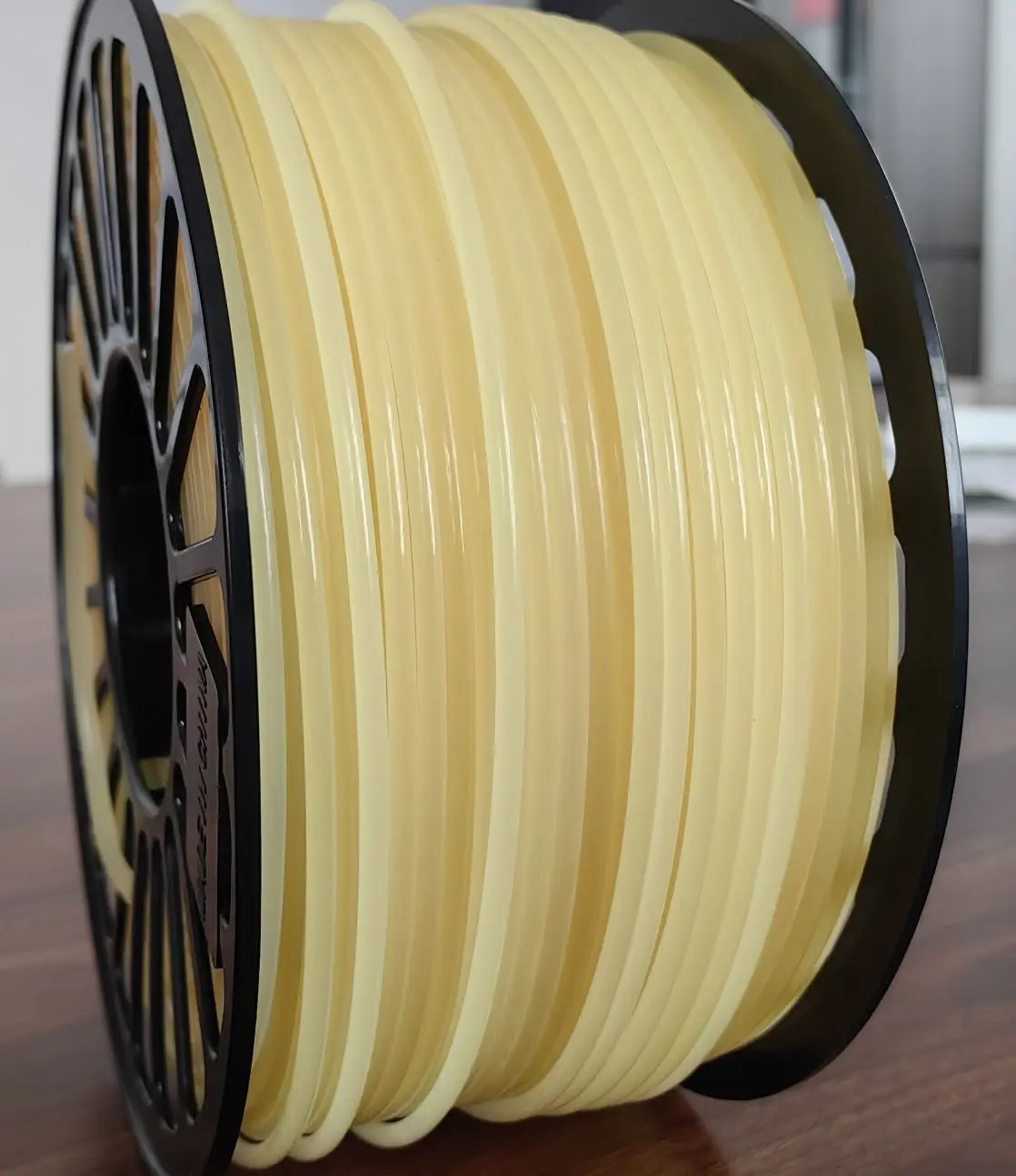
The back counter is the stiffened heel section that gives a shoe its shape at the back. Some call it the heel counter. The factory bonds it with a polyamide hot melt adhesive. United supplies that adhesive as UR-S970: a solid rod, coiled and sized to drop straight into the melt tank of a counter cementing machine. It is a single-component polyamide, 100% solids and solvent-free.
The machine melts it and lays a bead along the heel seat and counter line. The operator then presses the counter into place while the melt is still open.
A counter is asked to do two opposite things. First, it has to stay stiff enough to hold the heel curve through a million steps. Second, it must survive being flexed, knocked and stored in a warm place without the bond line creeping or opening.
That is why UR-S970 is polyamide rather than the softer EVA-based hot melts used on light counters. Because of that chemistry, polyamide gives a stiffer, higher-cohesive bond line with better heat stability. It also holds on leather, PU-coated leather, microfibre and cellulose counter board alike.
Rod form is what makes the process work on a production line. For example, there is no film to cut to the counter pattern, no release paper to strip, no powder to scatter and no solvent to dry off. The operator simply loads a coil and the machine feeds itself. When the press opens the bond has already set, so the cycle is set by the machine and not by an oven.
Key Features
- Polyamide (PA) chemistry — a stiff, high-cohesive bond line that holds the heel curve instead of creeping under load
- Better heat stability than EVA counter melts — the bond survives a closed container, a warm store room and a shoe box in transit
- Solid rod, coiled — loads straight into the tank: no film to cut, no release paper, no dust
- 100% solids, solvent-free — no solvent fume, no extraction ducting, no drying tunnel
- Sets on cooling — the counter sets the moment the press opens, so cycle time belongs to the machine
- Wide substrate coverage — leather, PU-coated leather, microfibre, textile and cellulose counter board
- Confirmed specifications — softening point 175 ± 5 °C, melt viscosity 10,000 ± 3,000 mPa·s (200 °C) and rod diameter 3.85 ± 0.15 mm
- One naming system for the rod range — UR-S970 is the back counter grade, UR-S971 the forepart grade: two coils, two labels on the shelf, no mix-up at the bench
Technical Specifications
| Property | Value |
|---|---|
| Appearance | Light yellow rod, coiled |
| Main component | Polyamide (PA) hot melt adhesive, single component |
| Rod diameter | 3.85 ± 0.15 mm |
| Softening point | 175 ± 5 °C |
| Melt viscosity | 10,000 ± 3,000 mPa·s (200 °C) |
| Bonding temperature | 200-220 °C |
| Setting time | 3-6 s |
| Solids content | 100% — no solvent, no water |
| Bond character | Stiff, high cohesive strength; sets by crystallisation on cooling |
| Substrates | Leather, PU-coated leather, microfibre, textile and cellulose counter board |
| Packaging | 12 coils / 20 kg / carton |
| Storage | Cool, dry, ventilated, out of direct sunlight; shelf life as stated on the datasheet |
Recommended Bonding Conditions
| Parameter | Value |
|---|---|
| Adhesive temperature | 200-220 °C (adjust within the band to bead size and line speed) |
| Substrate preparation | Bonding surfaces must be clean, dry and free of release agent |
| Application | The machine lays a bead along the heel seat and up the counter line |
| Assembly | The counter is positioned on the upper and pressed into the heel curve |
| Setting | 3-6 s; the melt crystallises as it cools, so the bond is fixed when the press opens — no oven, no clamp time |
Every counter machine and every counter construction behaves a little differently. Run a trial on your own board, upper and lining before volume production, to fix tank temperature, bead weight and press pressure. We will send samples for that trial.
Applications
- Formal and casual shoes — the standard counter bond for men’s and women’s lines
- Safety, work and uniform boots — stiff counters that must not soften or creep in service
- Children’s footwear — short cycles and small counters, with no oven in the line
- Moulded and pre-formed counters — bonding the counter into the heel before lasting
- Any counter line running a rod-fed tank — no film, no powder, no solvent
Choosing the Grade
Polyamide hot melts are not one product. UR-S970 is the model we quote for shoe back counters. Where a line needs a different softening point, viscosity or rod diameter, say so when you enquire and we will confirm what we can supply. Send us these five details with the datasheet request:
- The machine make and model, and the rod diameter its feed channel accepts
- The counter material and thickness (cellulose board, microfibre, TPU-coated)
- The upper and lining it has to bond to
- Your cycle time and the temperature the tank actually runs at
- The service conditions the finished shoe has to survive
Frequently Asked Questions
What is UR-S970?
UR-S970 is our polyamide (PA) hot melt adhesive rod for shoe back counters. It is a single-component, 100% solids rod, coiled and fed to a counter cementing machine. The UR prefix marks the rod range: UR-S970 is the counter grade and UR-S971 the forepart grade. Both are also supplied as coiled rod. Typical parameters are listed in the technical specifications above. The datasheet issued with your order remains the controlling document.
What is a back counter, and where does the adhesive go?
The back counter is the stiffened panel at the heel. It sits laminated between the upper and the lining, and it therefore stops the heel from collapsing. The adhesive goes between the counter and the upper. A bead runs along the heel seat and up the counter line, so the counter is bonded into the heel curve instead of only stitched in place.
Does a counter machine take rod or tape?
Rod. In practice, a rod is a round section of solid hot melt that drops into the melt tank and is fed by the machine. However, a tape is a flat film of adhesive carried on release paper and applied by laminating or stitching. They are different product forms, not two names for the same thing, and a rod-fed counter machine cannot run tape.
Chemistry and grade choice
Why polyamide rather than PES or TPU?
Polyamide gives the stiffest bond line of the three and the best heat stability, which is what a counter needs. PES is more flexible and sets faster, and it is the usual choice for foreparts. TPU is softer and more elastic, and it is used where the bond has to move with the material, such as films for textiles. Tell us the part and we will tell you which family fits.
What do you need from us to recommend a grade?
For that reason, we need five details. First, the machine make and model, and the rod diameter it accepts. Second, the counter material and thickness. Third, the upper and lining it has to bond to. Fourth, your cycle time and tank temperature. Finally, the service conditions the finished shoe has to survive. With those we can name a grade, send the datasheet and arrange a sample.
Is it solvent-free? Will it smell or fume?
Yes. It is a 100% solids polyamide with no solvent, so there is no solvent fume, no extraction ducting and no drying tunnel. As with any hot melt, run the tank at the temperature recommended for the grade. Running far above it is what causes smoking and charring.
Packing, MOQ and storage
How is it packed, what is the MOQ, and how should it be stored?
Packing is 12 coils per carton, 20 kg per carton. There is no fixed MOQ, so we discuss quantities according to your needs and trial orders are welcome. Samples are available once we know your machine and counter materials. Store the cartons cool, dry and out of direct sunlight. Keep opened coils clean, and use them within the shelf life stated on the datasheet.