
PES Hot Melt Adhesive for Shoe Foreparts UR-S971
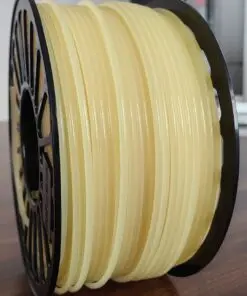
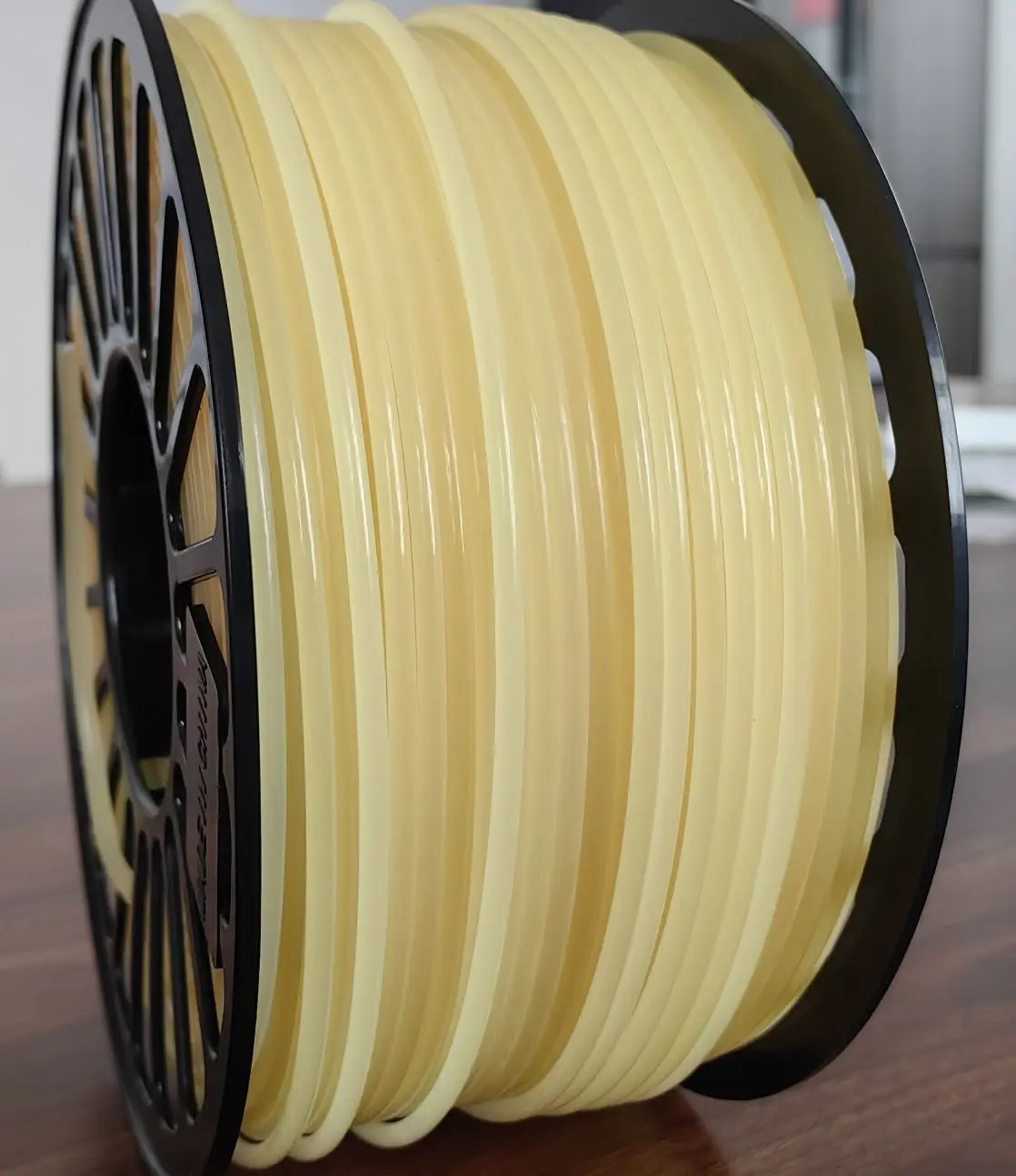
UR-S971 is a thermoplastic copolyester (PES) hot melt adhesive for shoe forepart bonding, supplied as milky-white rods of 3.85 ± 0.15 mm diameter, coiled and ready to feed. The round section runs through the feed channel without twisting, so the bead stays even.
It softens at 185 ± 5 °C and runs at 220–260 °C on the forepart cementing machine, and sets in 3–5 seconds as it cools — so the lasted forepart moves straight to the next station with no clamp time and no drying tunnel.
Forepart bonding is a high-cycle operation. The machine lays a bead of adhesive around the toe and forepart, then the operator folds the upper over the last and presses it. Because the shoe has to hold that shape from the first second onwards, we built UR-S971 for exactly that rhythm. It is a 100% solids thermoplastic, free of solvent. As a result, the bond stays tough and flexible, so it keeps its grip while the forepart creases and springs back through every step.
Key Features
- Sets in 3–5 seconds — the melt crystallises quickly on cooling, so the adhesive keeps pace with an automatic forepart line instead of holding it up
- Working window 220–260 °C, softening point 185 ± 5 °C — a forgiving band that keeps the bead flowable from tank to nozzle without scorching the polymer
- Rod diameter held to 3.85 ± 0.15 mm — consistent feed through the machine, with no jamming and no manual topping-up
- Tough, flexible bond with wide temperature tolerance — the forepart flexes thousands of times without cracking, whitening or creeping at the edge
- Solvent-free: no smoke, no odour, no VOCs — a cleaner workshop, no extraction ducting and no solvent-recovery cost
Technical Specifications
| Property | Value |
|---|---|
| Appearance | Milky white rod, coiled |
| Main component | Thermoplastic copolyester (Co-PES) |
| Rod diameter | 3.85 ± 0.15 mm |
| Softening point | 185 ± 5 °C |
| Melt viscosity | 25,000 ± 8,000 mPa·s (232 °C) |
| Bonding temperature | 220-260 °C |
| Setting time | 3-5 s |
| Packaging | 12 coils / 25 kg / carton |
| Storage | Ventilated, dry, dark room; shelf life approx. 12 months |
Recommended Bonding Conditions
| Parameter | Value |
|---|---|
| Adhesive temperature | 220-260 °C (adjust within the band to bead size and line speed) |
| Substrate preparation | Bonding area must be clean and dry |
| Application | Heat in the shoe forepart cementing machine and inject onto the parts |
| Assembly | Overlap the bonding surfaces and press |
| Setting | 3-5 s; the bond sets instantly while cooling, so no holding time is needed |
Run a small trial on your own upper and toe-puff materials before volume production. It fixes the optimum tank temperature, bead weight and press pressure, because every forepart machine and every upper construction behaves a little differently.
Applications
UR-S971 is the adhesive for the forepart operation, wherever a forepart is lasted:
- Shoe foreparts and toe areas — bonding the upper around the forepart on automatic forepart cementing machines
- Dress, casual and work footwear — wide adaptability across the upper materials and constructions used in general footwear production
- Children’s and small-size footwear — a 3–5 second set keeps short cycles short and keeps small lasts from springing open
- Any line running a rod-fed hot melt tank — no film to cut to shape, no powder handling, no solvent to dry off
Frequently Asked Questions
What is UR-S971 and where is it used?
UR-S971 is a co-polyester (PES) hot melt adhesive in rod form, used for shoe forepart bonding. The machine melts the rods in its tank and injects them onto the bonding area. The operator then folds the upper over the last and presses it while the adhesive sets in 3–5 seconds.
Is it a rod or a tape?
A rod: a round section of solid hot melt, 3.85 ± 0.15 mm across, coiled so it can drop straight into a melt tank. A tape is a flat film of adhesive on release paper, and you apply it by laminating or stitching, and a powder is for scatter coating on a flat web. All three are PES hot melt in different shapes, and you cannot swap them — a forepart machine is built to melt and inject a rod.
What temperature should the machine run at?
220–260 °C. The polymer itself softens at 185 ± 5 °C; running the tank inside the 220–260 °C band gives a bead that flows freely to the nozzle and still sets fast on the shoe. Start in the middle of the band and adjust to your machine, bead size and line speed.
How long before the lasted forepart can be handled?
3–5 seconds. Setting is by crystallisation on cooling, not by drying, so there is no clamp time and no oven. The exact time depends on bead weight, substrate and workshop temperature — confirm it on a trial at your line speed.
Does it contain solvent or give off fumes?
No. UR-S971 is a 100% solids thermoplastic with no solvent: no smoke, no odour and no VOCs. That also means no drying tunnel, no extraction ducting and no solvent-recovery cost on the line.
Which upper materials does it bond?
We formulate it for forepart bonding, and shoe factories describe it as strong and widely adaptable across general footwear uppers. Send us the upper, lining and toe-puff materials you actually run and we will confirm with a sample trial — adhesion always depends on the exact combination.
How is it packed, what is the MOQ, and can I get a sample?
12 coils per carton, 25 kg per carton. There is no fixed MOQ — quantities are discussed according to your needs and trial orders are welcome. Samples are available: tell us your machine type and application and we will send the right grade. Test reports such as SGS can be provided on request.
How should it be stored, and how long does it keep?
Keep the cartons in a ventilated, dry, dark room, away from direct sunlight and moisture. Shelf life is approximately 12 months. Reseal opened cartons and keep the rods clean — dust and moisture on the rod surface go straight into the melt tank.